Fundamentals
The concepts everyone uses and almost nobody defines: what an API, an SDK, a backend or a database really are.
Frontend
from code to browser
A web frontend is the HTML, CSS, and JavaScript that a server delivers to the browser to build an interface.
HTML defines the structure, CSS decides how it looks, and JavaScript lets it change and respond to each action. However much React, Vue, or Angular you use, those are the three things the browser understands in the end.
Before it reaches the browser
When you run npm run dev, you usually start a development server. Tools such
as Vite transform the code and update the browser as soon as you save a file.
It is built to make development comfortable, not to receive real traffic.
To publish the application, you run a build. The bundler walks through the code, removes what is not used, splits the result, and generates something like this:
dist/
├── index.html
├── assets/app-a91f2.js
├── assets/styles-77c3a.css
└── assets/logo-2d10f.webp
Those files can be served by Nginx, a bucket, or a CDN. Hashed names let them remain cached for a long time: when the content changes, the URL changes too and the browser downloads the new version.
There are exceptions. A frontend using server-side rendering —SSR— may need a production process that builds the HTML for each request. Even then, the browser ultimately receives HTML, CSS, and JavaScript.
Inside the browser
The browser turns HTML into an object tree called the DOM. JavaScript can add nodes, change text, or remove elements, and the browser paints whatever needs updating.
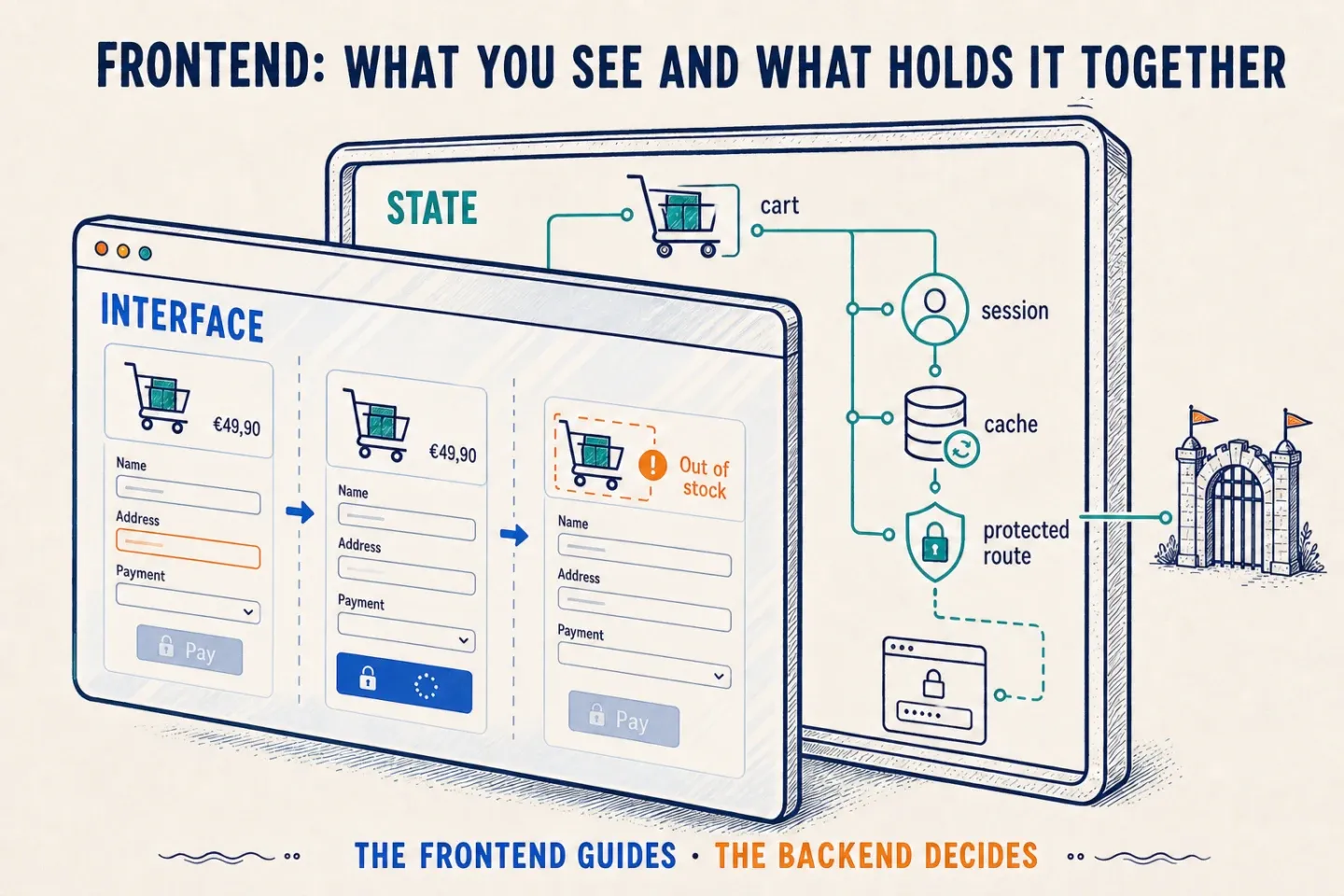
To decide what to paint, the application needs to know what is happening. If a cart appears in the header and at checkout, both places must show the same products. That information is state.
If only one component uses a value, it can live there. If its children need it too, it can travel through props. Prop drilling appears when it crosses several components that do not use it just to reach another one; Context, Redux, and Zustand let it be shared without passing through the entire chain.
The point is not to store everything globally. The closer data lives to where it is consumed, the fewer parts of the application can change it or depend on it without a reason.
React connects that state to the screen through an in-memory representation called the virtual DOM. When state changes, it compares the previous result with the new one and applies the necessary changes to the real DOM. It is not another kind of HTML or something the browser understands; it is React’s strategy for deciding what to touch.
Routes answer a similar question: which interface belongs to each URL. React Router can decide in the browser; Astro can generate the HTML during the build; Next.js can render it on the server as well.
When it talks to the backend
Imagine you are confirming an order. The frontend already knows whether the address is missing, so it can keep the button disabled. When you press it, it can lock the button while it waits instead of sending the operation twice. And if the backend says a product has gone out of stock, it can show which one and what you can do next.
This is where the visual and technical sides meet. The screen must represent whether the request is loading, completed, or failed; the backend must return errors the frontend can turn into useful messages.
Data from the API is remote state. The product list on screen is a copy and can become stale. A request cache can reuse it for a period —a five-minute TTL, for example— and avoid more network calls. It also needs to know when to invalidate it: after creating an order, stock may need fetching even if the TTL has not ended.
The session follows the same journey. The frontend can use it to protect a route and send you to login before showing a private screen. That improves the experience, not security: anyone can alter the browser or call the API directly, so the backend checks the permissions again.
⚠️ A frontend is not just “the pretty part”, but it is not a second backend either. It is the code that reaches the browser and keeps the interface coherent while someone uses it.