Fundamentals
The concepts everyone uses and almost nobody defines: what an API, an SDK, a backend or a database really are.
Types of APIs
four web styles
APIs come in many forms: a library, a CLI or a messaging topic are APIs too. But when we talk about a web API, these four styles come up most often.
REST: resources and HTTP
REST organises an API around resources: products, orders or users. The URL identifies the resource and the HTTP method expresses the action:
GET /products/42

{ "id": 42, "name": "Backpack", "price": 59 }
It commonly uses JSON and works especially well for straightforward CRUD operations. It is not a protocol or a specific implementation: it is a set of constraints for designing the interface.
SOAP: a formal contract
SOAP defines operations and XML messages through an explicit contract, usually a WSDL. The request does not say “give me this resource”; it says “run this operation”.
<GetOrder><id>42</id></GetOrder>It is more rigid and verbose than REST, but that formality remains useful in enterprise integrations where the contract and its rules must be tightly defined.
GraphQL and gRPC: two other approaches
With GraphQL, the client selects the exact fields it needs in a query against a schema. A screen can therefore ask for a name and price without receiving fields it will not use.
With gRPC, services declare their calls and messages in Protocol Buffers. It is common between internal services: the contract generates typed clients and communication is compact and efficient.
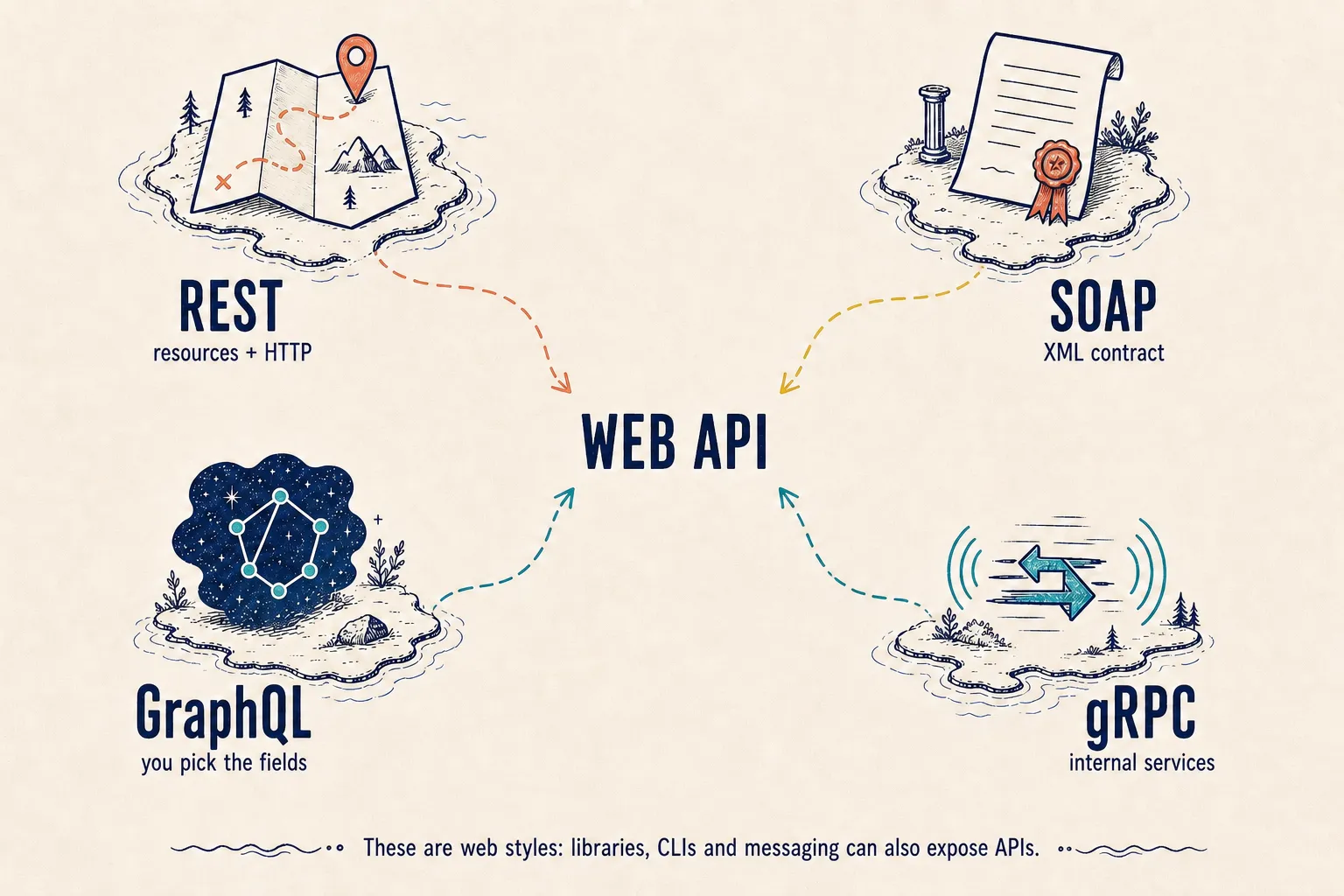
⚠️ REST, SOAP, GraphQL and gRPC are not “the four types of APIs”. They are four styles often seen on the web. The same contract idea also appears in a function, a command or a Kafka message.